
Table of Contents
Asiatic Lion: Overview and Lion Species
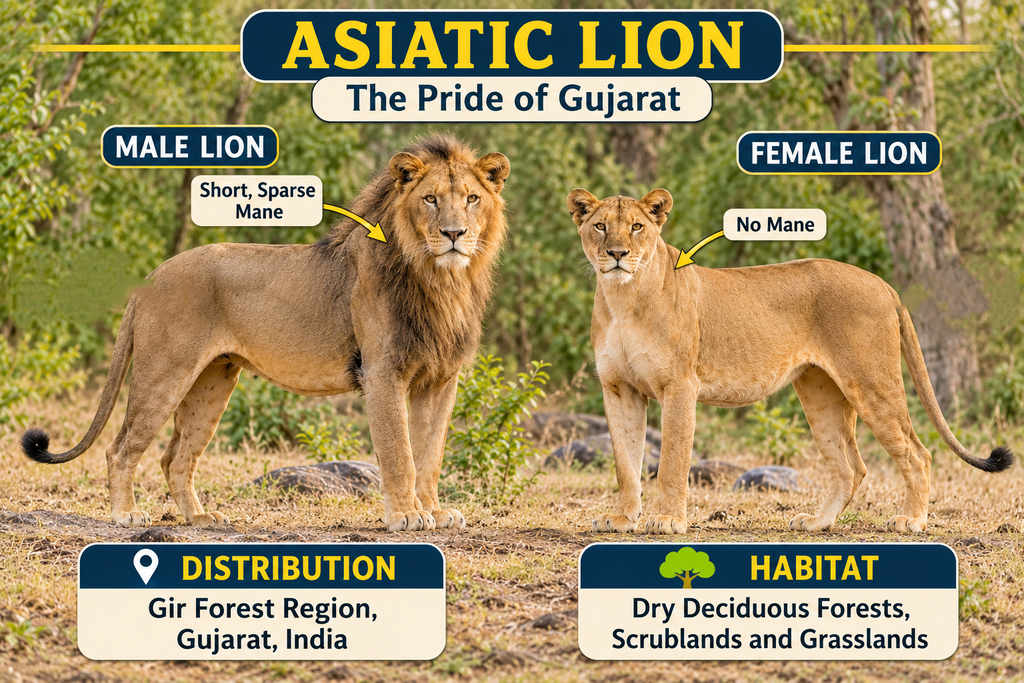
The Asiatic Lion (Panthera leo persica), also known as the Indian Lion or Persian Lion, is a large carnivorous mammal native to the Indian subcontinent. It is smaller and has a less-developed mane than the African Lion. Today, the Asiatic Lion is primarily restricted to the Gir Forest region of Gujarat, India, and is classified as Endangered on the IUCN Red List.
- Scientific Name: Panthera leo persica.
- Common Names: Indian Lion and Persian Lion.
- Lion Species: There are two recognized lion subspecies:
- African Lion (Panthera leo): Found in sub-Saharan Africa; generally larger in size and has a more developed mane.
- Asiatic Lion (Panthera leo persica): Found in India; smaller than the African Lion, with a distinctive belly fold and a less-developed mane.
Distribution of Asiatic Lion in the World and India
- Historical Global Distribution: The Asiatic Lion historically ranged across West Asia, the Middle East, and the Indian subcontinent.
- Present Global Distribution: Today, its natural wild population is restricted to India.
- Distribution in India: Asiatic Lions were once found across a much wider region, extending from Gujarat towards West Asia. Currently, they are primarily confined to Gir National Park, Gir Wildlife Sanctuary, and nearby forests in the Saurashtra region of Gujarat.
- Second Home: Kuno Wildlife Sanctuary in Madhya Pradesh is being developed as an additional habitat through an ongoing lion reintroduction project.
- National Parks and Protected Areas:
- Gir National Park, Gujarat.
- Gir Wildlife Sanctuary, Gujarat.
- Pania Wildlife Sanctuary, Gujarat.
- Natural Stronghold: Gir Forest and its surrounding protected areas in Gujarat are the primary natural habitat and stronghold of the Asiatic Lion.
Habitat of Asiatic Lion
- Forest Habitat: Asiatic Lions primarily inhabit dry deciduous forests.
- Scrublands: They are also found in scrublands and areas with scattered vegetation.
- Grasslands: Open grasslands provide important feeding and movement areas.
- Water Sources: They prefer habitats close to water sources, which are essential for drinking and survival.
- Altitude Range: Their habitat generally extends up to 300 metres above sea level.
- Geographical Habitat: The Gir region of Gujarat provides a combination of dry forests, scrublands, and open grasslands that support the Asiatic Lion population.
Physical Characteristics and Unique Features of Asiatic Lion
- Fur Colour: Tawny-golden fur covering the body.
- Mane: Male Asiatic Lions have a short and sparse mane, which is less developed than that of African Lions.
- Belly Fold: A distinctive longitudinal fold of skin along the belly is a characteristic feature of the Asiatic Lion.
- Muscular Build: It has a strong and muscular body.
- Head: A broad head with small, rounded ears.
- Limbs: Strong limbs help it run, hunt, and move across its habitat.
- Tail: The tail has a tuft of hair at the tip.
- Unique Features: The Asiatic Lion is distinguished by its belly fold, smaller mane, and adaptation to dry forest habitats. It is also generally less territorial than African Lions.
- Cultural Significance: The Asiatic Lion is culturally iconic in Gujarat and is popularly associated with the identity of the state as “The Pride of Gujarat.”
Size and Weight of Asiatic Lion
- Male Asiatic Lion:
- Weight: 160–190 kg.
- Body Length: 2.2–2.5 metres.
- Female Asiatic Lion:
- Weight: 120–180 kg.
- Body Length: 2–2.3 metres.
Diet and Feeding Habits of Asiatic Lion
- Diet Type: The Asiatic Lion is a carnivorous mammal.
- Primary Prey: It primarily hunts herbivorous animals, including:
- Chital (spotted deer).
- Sambar.
- Nilgai.
- Wild boar.
- Other Food Sources: Asiatic Lions occasionally prey on livestock, particularly in areas near human settlements.
- Feeding Behaviour: They hunt and feed on a variety of wild ungulates and other available herbivores.
Behaviour and Social Structure of Asiatic Lion
- Social Behaviour: Asiatic Lions are social animals that live in small groups called prides.
- Group Size: Their prides are generally smaller than those of African Lions.
- Territorial Behaviour: Male Asiatic Lions are territorial and defend their territories.
- Activity Pattern: They are crepuscular, meaning they are mainly active during dawn and dusk.
- Swimming Ability: Asiatic Lions are good swimmers.
- Communication: They communicate through vocalizations such as roars, grunts, and growls.
Reproduction of Asiatic Lion
- Breeding Season: Asiatic Lions can breed throughout the year, with no strictly defined breeding season.
- Gestation Period: The gestation period ranges from 100 to 119 days.
- Litter Size: Female lions generally give birth to 1–4 cubs per litter.
- Sexual Maturity:
- Females: Reach sexual maturity at 3–4 years.
- Males: Reach sexual maturity at 4–5 years.
Lifespan of Asiatic Lion
- In the Wild:
- Females: Typically live for 12–16 years.
- Males: Typically live for 8–12 years.
- In Captivity: Asiatic Lions can live for up to 20 years.
Population of Asiatic Lion in India
- Total Population in India: The Asiatic Lion population in India was estimated at approximately 674 individuals in the 2020 population estimate.
- Gir Forest, Gujarat: Gir Forest and its surrounding areas account for the entire naturally established wild population of Asiatic Lions.
- Kuno Wildlife Sanctuary, Madhya Pradesh: A lion reintroduction project is underway to establish an additional population outside Gujarat.
- Population Monitoring: Population surveys and monitoring are important for tracking population growth, distribution, and conservation progress.
Conservation Status, Project Lion and Major Threats to Asiatic Lion
- IUCN Red List Status: Endangered.
- CITES: Listed under Appendix I.
- Indian Legal Protection: Protected under Schedule I of the Wildlife (Protection) Act, 1972.
- Project Lion: Launched on August 15, 2020, to strengthen the long-term conservation of Asiatic Lions.
- Population Protection: Aims to protect and increase the Asiatic Lion population.
- Genetic Diversity: Focuses on improving genetic diversity to reduce the risks associated with a small and isolated population.
- Human-Lion Conflict: Aims to mitigate conflicts between humans and lions.
- Gene Pool Sites: Plans to create additional gene pool sites at Rampara, Sakkarbaug, and Satveerada.
- Historical Conservation: Nawab Sir Muhammad Mahabat Khan III of Junagadh contributed to Asiatic Lion protection in the 19th century by banning hunting and establishing the Gir Forest Reserve.
- Major Threats:
- Habitat Loss: Reduction and degradation of natural habitats threaten lion populations.
- Human-Lion Conflict: Conflicts with local communities, particularly over livestock, create conservation challenges.
- Poaching: Illegal hunting remains a threat to the species.
- Small Population: The limited population increases the risk of extinction from disease outbreaks and other unexpected events.
- Low Genetic Diversity: Limited genetic variation increases the risk of inbreeding and genetic disorders.
- Disease Outbreaks: Infectious diseases can affect a large proportion of the small lion population.
Asiatic Lion vs. African Lion
| Feature | Asiatic Lion | African Lion |
|---|---|---|
| Scientific Name | Panthera leo persica | Panthera leo |
| Population | ~891 (India, 2025) | 20,000–25,000 (Africa, 2025) |
| Distribution | Gir Forest, Gujarat; Kuno, MP (reintroduction) | Sub-Saharan Africa; savannas, grasslands, woodlands |
| Male Size | 160–190 kg; 2.2–2.5 m | 150–250 kg; 2.7–3 m |
| Female Size | 120–180 kg; 2–2.3 m | 120–180 kg; 2.3–2.6 m |
| Distinctive Features | Belly fold; sparse mane; smaller prides | Large mane; larger prides; more social |
| Habitat | Dry deciduous forests, grasslands | Savannas, grasslands, woodlands |
| Diet | Deer, nilgai, wild boar, occasional livestock | Zebras, antelopes, wildebeest, buffalo |
| Behaviour | Small prides; territorial males; crepuscular | Large prides; highly social; territorial |
| Reproduction | Cubs 1–4; gestation 100–119 days; sexual maturity F 3–4 yrs, M 4–5 yrs | Cubs 1–4; gestation 100–110 days; sexual maturity F 3–4 yrs, M 4–5 yrs |
| Speed | ~50 km/h | ~50 km/h |
| Conservation Status | Endangered (IUCN); Schedule I WPA; CITES I | Vulnerable (IUCN); CITES II |
| Major Threats | Small population, habitat loss, poaching, inbreeding | Habitat loss, human-lion conflict, poaching |