
The Nilgiri Biosphere Reserve is a UNESCO-designated biosphere reserve located in the Western Ghats of India. The reserve is named after the Nilgiri Hills, which form part of the Western Ghats mountain range.
The Nilgiri Biosphere Reserve is located in southern India and extends across the states of Tamil Nadu, Kerala, and Karnataka. It includes well-known places such as Ooty and Coonoor in Tamil Nadu and Wayanad in Kerala. The reserve also covers parts of the Nilgiri district in Tamil Nadu, Malappuram district in Kerala, and Chamarajanagar district in Karnataka, along with adjoining forest areas.
The Nilgiri Biosphere Reserve was India’s first biosphere reserve designated by the Government of India. It was also India’s first biosphere reserve to be included under UNESCO’s Man and the Biosphere Programme.
The reserve contains a diverse landscape of forests, grasslands, wetlands, and river catchments. These varied habitats support a wide range of plant and animal species, including several endangered and endemic species such as the Nilgiri tahr, lion-tailed macaque, and Nilgiri langur.
The Nilgiri Biosphere Reserve is also important for the conservation of the Western Ghats, as it encompasses several protected areas and landscapes traditionally inhabited by indigenous tribal communities.
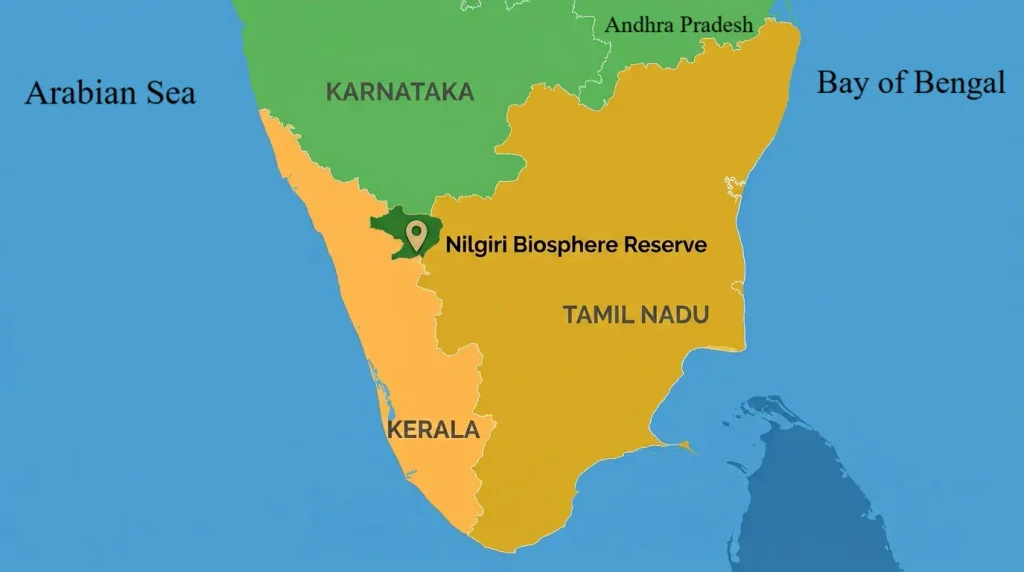
Table of Contents
History of Nilgiri Biosphere Reserve
The conservation history of the Nilgiri region developed gradually through forest regulation, protected-area management, and later landscape-level biodiversity conservation.
- 1882: The Madras Forest Act provided a legal framework for regulating forest use and managing forest resources in the Madras Presidency, including the Nilgiri region.
- 1936: The Nilgiri Wildlife Sanctuary was established as an early step towards protecting the region’s wildlife and natural habitats.
- 1986: The Nilgiri Biosphere Reserve was designated as the first biosphere reserve in India by the Government of India.
- 2000: The Nilgiri Biosphere Reserve was included in UNESCO’s Man and the Biosphere (MAB) Programme, giving it international recognition for biodiversity conservation and sustainable development.
- 2012: The Western Ghats were inscribed on the UNESCO World Heritage List because of their outstanding biodiversity and ecological significance. The Nilgiri landscape forms an important part of this larger Western Ghats region.
The establishment of the Nilgiri Biosphere Reserve marked a shift from protecting individual forests and wildlife areas towards a broader approach that combines biodiversity conservation, sustainable use of natural resources, and the interests of local communities.
Area and Zonation of Nilgiri Biosphere Reserve
The Nilgiri Biosphere Reserve covers about 5,520 square kilometres (2,131 square miles) across Tamil Nadu, Kerala, and Karnataka. The reserve is divided into core, buffer, and transition zones according to the level of protection and human activities permitted in each zone.
| Zone | Area |
|---|---|
| Core area | 1,240 sq. km. |
| Buffer zone | 3,574 sq. km. |
| Transition zone | 706 sq. km. |
| Total | 5,520 sq. km. |
The reserve is spread across three states, with the largest share falling in Tamil Nadu. The state-wise distribution is:
| State | Area |
|---|---|
| Tamil Nadu | 2,537.6 sq. km. |
| Kerala | 1,455.4 sq. km. |
| Karnataka | 1,527.4 sq. km. |
| Total | 5,520.4 sq. km. |
The slight difference in the state-wise total from the overall figure of 5,520 sq. km. is due to rounding in the state-wise figures.
Protected Areas in Nilgiri Biosphere Reserve
The Nilgiri Biosphere Reserve includes several important national parks and wildlife sanctuaries spread across Tamil Nadu, Kerala, and Karnataka. These protected areas conserve different ecosystems of the Western Ghats and provide important habitats for the region’s wildlife.
National Parks in Nilgiri Biosphere Reserve
The major national parks associated with the Nilgiri Biosphere Reserve are:
| National Park | State |
|---|---|
| Bandipur National Park | Karnataka |
| Nagarahole National Park | Karnataka |
| Mukurthi National Park | Tamil Nadu |
| Silent Valley National Park | Kerala |
Wildlife Sanctuaries in Nilgiri Biosphere Reserve
Several wildlife sanctuaries also form part of the protected-area network associated with the Nilgiri Biosphere Reserve. They help protect forest habitats and maintain ecological connectivity across the wider Nilgiri landscape.
| Wildlife Sanctuary | State |
|---|---|
| Mudumalai Wildlife Sanctuary | Tamil Nadu |
| Sathyamangalam Wildlife Sanctuary | Tamil Nadu |
| Wayanad Wildlife Sanctuary | Kerala |
Hills and Major Peaks of Nilgiri Biosphere Reserve
The Nilgiri Biosphere Reserve is named after the Nilgiri Hills, which form an important part of the Western Ghats in southern India. The landscape includes high-elevation hills, montane forests, grasslands, and valleys.
The highest peak of the Nilgiri Hills is Doddabetta, rising to 2,637 metres (8,650 feet) above sea level. Mukurthi Peak is another important high-altitude peak in the Nilgiri Hills.
Rivers in Nilgiri Biosphere Reserve
The Nilgiri Biosphere Reserve includes several important rivers and their catchment areas. The Bhavani, Moyar, and Kabini are major tributaries of the Cauvery and have their origins in or around the reserve. These rivers are important for water supply, irrigation, wildlife habitats, and the ecological balance of the region.
| River | Origin / Course | Importance |
|---|---|---|
| Bhavani River | Originates in the Nilgiri Hills of the Western Ghats and flows through the Silent Valley National Park before entering Tamil Nadu and joining the Cauvery | Major tributary of the Cauvery; important for water flow and irrigation |
| Moyar River | Originates in the Mudumalai Wildlife Sanctuary and flows through Tamil Nadu and Karnataka before joining the Bhavani River | Important water source for wildlife and surrounding human settlements |
| Kabini River | Begins in the Wayanad Wildlife Sanctuary in Kerala and flows through Karnataka before joining the Cauvery | Major Cauvery tributary; supports important wildlife habitats and the Kabini Reservoir |
| Chaliyar River | Flows through the northern part of the Nilgiri–Wayanad landscape | Contributes to the region’s water resources and ecological systems |
| Punampuzha River | A river associated with the Nilgiri–Wayanad landscape | Contributes to local water resources and ecological balance |
Lakes and Reservoirs of Nilgiri Biosphere Reserve
The Nilgiri Biosphere Reserve and its surrounding areas contain several notable lakes and reservoirs. These water bodies contribute to the ecological diversity of the region and provide habitats for aquatic flora and fauna.
| Lake / Reservoir | Location | Key Features |
|---|---|---|
| Pykara Lake | Near Pykara village and Ooty, Tamil Nadu | Surrounded by green hills and forests; known for boating and scenic views |
| Avalanche Lake | Near Avalanche village, Nilgiri Hills | Surrounded by mountains and forests; known for nature walks and birdwatching |
| Upper Bhavani Lake | Near Avalanche village, Tamil Nadu | Reservoir formed by a dam across the Bhavani River; surrounded by the Nilgiri Hills |
| Emerald Lake | Near Emerald village, Tamil Nadu | Surrounded by tea estates and hills; known for its tranquil natural setting |
| Pookode Lake | Wayanad district, Kerala | Located near the reserve rather than within it; known for its distinctive shape resembling the map of India from above |
Plants of Nilgiri Biosphere Reserve
The Nilgiri Biosphere Reserve has rich floral diversity across forests, grasslands, wetlands, and high-altitude ecosystems. Important vegetation types and plant species include:
- Shola Forests: Tropical montane forests found mainly at higher elevations of the Nilgiri Hills. They include stunted trees, moss-covered rocks, dense undergrowth, orchids, rhododendrons, and ferns.
- Evergreen Forests: These forests include important tree species such as Indian rosewood (Dalbergia latifolia), black dammar (Canarium strictum), and Malabar ironwood (Mesua ferrea).
- Grasslands: The montane grasslands contain grasses such as Themeda, Chrysopogon, and Arundinella.
- Medicinal Plants: Important medicinal plants include Rauvolfia serpentina, Gloriosa superba, and Gymnema sylvestre, which are associated with traditional medicinal practices.
- Endemic Plants: The region supports endemic and restricted-range plants, including species of Impatiens, Pterocarpus, and Strobilanthes.
- Wetland Flora: Wetlands, lakes, and marshes support plants such as Nelumbo nucifera (lotus), Nymphaea species (water lilies), and various aquatic grasses and reeds.
Animals of Nilgiri Biosphere Reserve
The Nilgiri Biosphere Reserve is known for its rich and diverse fauna, supported by its forests, grasslands, wetlands, and varied elevations. It provides habitat to several important mammals, birds, reptiles, and other species of the Western Ghats.
- Mammals: Asian Elephant, Bengal Tiger, Leopard, Gaur, Sambar, Spotted Deer, Dhole, Wild Boar, Slender Loris, Nilgiri Tahr, Nilgiri Langur, and Lion-tailed Macaque.
- Birds: Nilgiri Pipit, Nilgiri Laughingthrush, Nilgiri Wood Pigeon, Nilgiri Blue Robin, and other forest and montane bird species.
- Reptiles: Indian Rock Python, King Cobra, Malabar Pit Viper, and Travancore Tortoise.
- Endemic and restricted-range species: Nilgiri Tahr, Nilgiri Langur, Nilgiri Pipit, Nilgiri Laughingthrush, Nilgiri Wood Pigeon, Nilgiri Blue Robin, and several other species associated with the Western Ghats.
- Threatened species: The reserve provides habitat for several threatened species, including the Nilgiri Tahr, Bengal Tiger, Lion-tailed Macaque, Nilgiri Laughingthrush, and Travancore Tortoise.
The presence of endemic and threatened species makes the Nilgiri Biosphere Reserve an important area for wildlife conservation in the Western Ghats.
Tribal Communities of Nilgiri Biosphere Reserve
The Nilgiri Biosphere Reserve is home to several indigenous tribal communities with distinct cultures, traditions, and traditional knowledge of the local environment.
| Tribal Community | Traditional Lifestyle and Cultural Features |
|---|---|
| Todas | Known for their distinct culture and language, traditional dwellings called munds, and pastoral activities |
| Kotas | Known for their own language, customs, and traditions, with traditional expertise in iron smelting and pottery |
| Irulas | Traditionally involved in agriculture, snake catching, and collection of forest produce |
| Kurumbas | Closely connected with the forests and traditionally involved in hunting, gathering, and herbal medicine |
| Paniyas | Mainly associated with Wayanad and traditionally engaged in agriculture and labor-intensive activities |
| Cholanaickens | Also known as Cholanaikas; traditionally followed a hunter-gatherer lifestyle and depended on forest-based resources |
| Allar | Traditionally involved in agriculture, animal husbandry, and collection of non-timber forest products |
Nilgiri Biosphere Reserve FAQs
Q. Where is the Nilgiri Biosphere Reserve located?
The Nilgiri Biosphere Reserve is located in southern India and extends across parts of Tamil Nadu, Kerala, and Karnataka. It forms part of the Western Ghats and includes parts of the Nilgiri, Wayanad, Malappuram, and Chamarajanagar districts.
Q. What is the Nilgiri Biosphere Reserve?
The Nilgiri Biosphere Reserve is a protected ecological landscape in the Western Ghats known for its rich biodiversity and varied ecosystems, including forests, grasslands, wetlands, and high-elevation habitats.
Q. When was the Nilgiri Biosphere Reserve established?
The Nilgiri Biosphere Reserve was established in 1986 by the Government of India. It was the first biosphere reserve to be designated in India.
Q. Which national parks are part of the Nilgiri Biosphere Reserve?
The major national parks associated with the Nilgiri Biosphere Reserve are:
Bandipur National Park — Karnataka
Nagarahole National Park — Karnataka
Mukurthi National Park — Tamil Nadu
Silent Valley National Park — Kerala
Q. Which wildlife sanctuaries are part of the Nilgiri Biosphere Reserve?
Important wildlife sanctuaries associated with the Nilgiri Biosphere Reserve include:
Mudumalai Wildlife Sanctuary — Tamil Nadu
Sathyamangalam Wildlife Sanctuary — Tamil Nadu
Wayanad Wildlife Sanctuary — Kerala
Q. Is the Nilgiri a Biosphere Reserve?
Yes. The Nilgiri Biosphere Reserve is a recognized biosphere reserve in India. It was designated in 1986 and was the first biosphere reserve established in the country.
Q. Which was the first Biosphere Reserve in India?
The Nilgiri Biosphere Reserve was the first biosphere reserve established in India. It was designated in 1986 and covers parts of Tamil Nadu, Kerala, and Karnataka in the Western Ghats.