
The Siachen Glacier, located in the Eastern Karakoram range north of Ladakh’s Nubra Valley, is the world’s highest battlefield, controlled by India since Operation Meghadoot in 1984. It is crucial for India as a strategic barrier separating Pakistan-occupied Kashmir (PoK) from China, preventing their direct military alliance.
Table of Contents
Location of Siachen Glacier
- Location: The Siachen Glacier is located in the eastern Karakoram Range in northern Ladakh, between the Saltoro Ridge to the west and the main Karakoram Range to the east. It lies close to the strategically sensitive tri-junction of India, Pakistan, and China.
- Position & Orientation: The glacier extends in a northwest-to-southeast direction, originating near Indira Col West, a col (low point) on the Indira Ridge, at an altitude of about 6,115 metres and descending to nearly 3,570 metres.
- LOC & NJ9842: The glacier lies northeast of Point NJ9842, the point where the officially demarcated Line of Control between India and Pakistan ends.
- Third Pole Region: Siachen lies south of the major drainage divide separating the Eurasian Plate from the Indian subcontinent in the heavily glaciated Karakoram region, often referred to as the “Third Pole” because of its massive freshwater reserves outside the polar regions.
- Indian Administration: The entire glacier, including key passes and surrounding heights, has remained under Indian control since Operation Meghdoot in 1984.
- Nearby Strategic Areas: The glacier is located close to important regions such as the Karakoram Pass, Shaksgam Valley, and Aksai Chin, enhancing its geopolitical importance.
Siachen Glacier Map
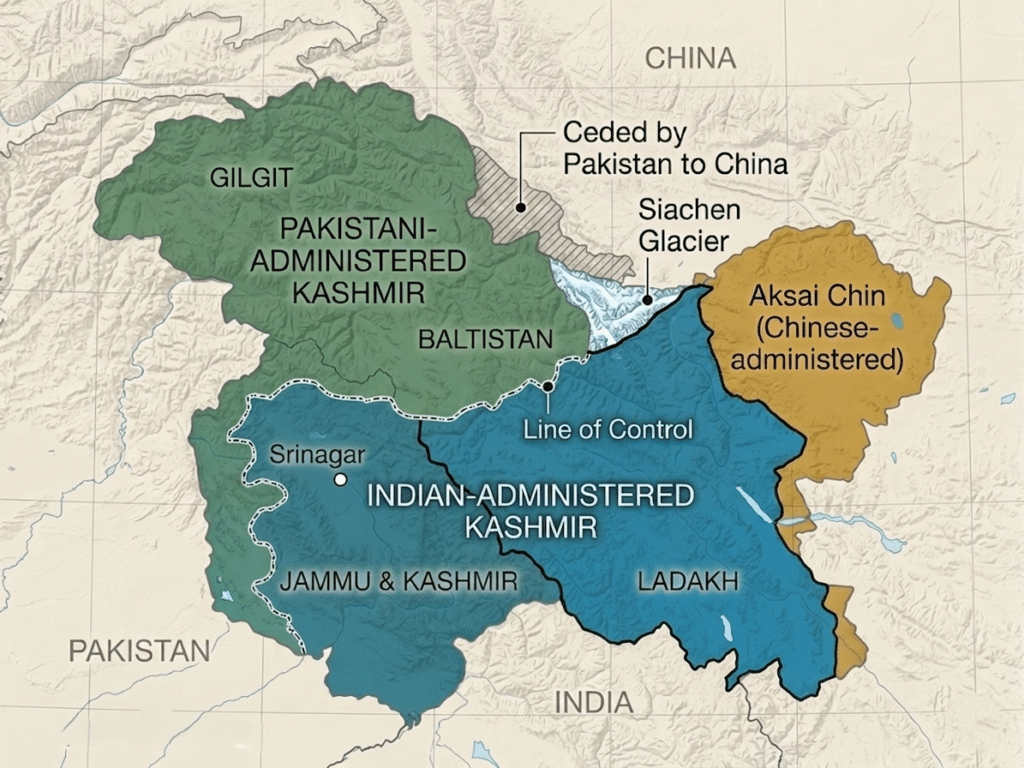
Physical Geography of Siachen Glacier
- Siachen Glacier Length: The Siachen Glacier is approximately 75 to 78 kilometers (47 to 48 miles) long.
- Second Longest Glacier: The Siachen Glacier s the longest glacier in the Karakoram and the second longest non-polar (and second longest in the world’s non-polar areas) glacier after the Fedchenko Glacier in Tajikistan.
- Glacial Type: It is a valley glacier formed through long-term accumulation, compaction, and recrystallization of snow into dense glacial ice.
- Altitude Range: The glacier extends from around 3,570 metres at the snout to more than 6,000 metres in the upper reaches, while surrounding peaks rise above 7,000 metres.
- Relief Features: The terrain is dominated by crevasses, ice cliffs (seracs), unstable ice walls, steep rocky slopes, and moraines, making movement extremely dangerous.
- Climate Conditions: Siachen experiences an extreme cold desert climate with very low precipitation, intense winds, and temperatures remaining below freezing for most of the year.
- Extreme Habitat: Siachen is considered one of the coldest and most inhospitable inhabited regions on Earth.
- Temperature: The environment at Siachen remains subzero for approximately 90% of the year.
- Winter: Temperatures typically range from -20°C to -40°C. In severe cases, they can plummet to -50°C or lower.
- Summer: Conditions are relatively milder, with average temperatures occasionally reaching up to 10°C.
- Record Lows: The lowest recorded temperature in the region reached -60°C during the winter of 1987.
- Siachen Glacier River: The Siachen Glacier is the primary source of the Nubra River, which flows through Nubra Valley and joins the Shyok River before ultimately becoming part of the Indus River system.
- Etymology: In the local Balti language, “Sia” means rose and “Chen” means abundance, giving the name Siachen the meaning “Land of Abundant Roses.”
Strategic & Military Significance of Siachen Glacier
- World’s Highest Battlefield: Siachen Glacier is known as the world’s highest battlefield, where Indian and Pakistani troops are deployed at altitudes exceeding 6,000 metres (20,000 ft).
- Operation Meghdoot (1984): India launched this operation on April 13, 1984, to preempt a Pakistani move (Operation Ababeel). India gained control of the entire glacier and major passes like Sia La, Bilafond La, and Gyong La.
- Geopolitical Buffer: The glacier acts as a strategic wedge between Pakistan-occupied Gilgit-Baltistan and China-occupied Aksai Chin, preventing direct military linkage between the two regions.
- Saltoro Ridge Control: India occupies key heights along the Saltoro Ridge, which overlooks the glacier and provides tactical dominance.
- Karakoram Pass Monitoring: Control over the glacier enhances India’s ability to monitor the ancient Karakoram Pass and nearby strategic corridors.
- Shaksgam Valley Significance: The glacier overlooks the Shaksgam Valley, which was ceded illegally to China by Pakistan in 1963.
- CPEC Proximity: The China–Pakistan Economic Corridor (CPEC) passes relatively close to the region, increasing Siachen’s geopolitical relevance for India.
- Two-Front Security Concern: Growing military cooperation between China and Pakistan has increased the strategic importance of Siachen in the context of a potential two-front conflict scenario.
- AGPL: The Actual Ground Position Line (AGPL) presently separates Indian and Pakistani military positions across the Saltoro Ridge region.
- Gateway to Ladakh: Control over the Siachen region also helps secure northern approaches toward Leh and other strategically important parts of Ladakh.
Historical Background of Siachen Glacier
- Origins of the Dispute: The roots of the Siachen conflict emerged after the first India–Pakistan war (1947–48), when a UN-brokered ceasefire line was established between the two countries.
- Karachi Agreement (1949): Under the Karachi Agreement, the ceasefire line was officially demarcated only up to Point NJ9842, after which the agreement vaguely stated “thence north to the glaciers,” leaving the Siachen region undefined.
- Boundary Ambiguity: The lack of clear demarcation beyond NJ9842 created differing interpretations by India and Pakistan regarding the ownership of the glacier region.
- India’s Position: India interpreted the boundary line as extending northward toward the glaciers based on the Instrument of Accession and the Karachi Agreement.
- Pakistan’s Interpretation: Pakistan interpreted the line as extending northeast toward the Karakoram Pass, thereby claiming the Siachen region.
- Cartographic Aggression: During the late 1970s, Pakistan began permitting foreign mountaineering expeditions in the Siachen region, attempting to strengthen its territorial claims through international maps and expeditions.
- Simla Agreement (1972): After the 1971 India–Pakistan war, the Simla Agreement converted the ceasefire line into the Line of Control but retained the same ambiguity beyond NJ9842.
- Operation Meghdoot (1984): In April 1984, India launched Operation Meghdoot and secured control over the glacier and strategic passes along the Saltoro Ridge before Pakistan could occupy them.
- Indian Control: Since Operation Meghdoot, the entire Siachen Glacier and major surrounding heights have remained under Indian administration.
- AGPL Formation: The Actual Ground Position Line (AGPL) later emerged as the practical military boundary separating Indian and Pakistani troop positions in the Siachen sector.
- 2003 Ceasefire: Following the 2003 ceasefire agreement along the LoC and AGPL, large-scale firing incidents reduced significantly, although military deployment continues in the region.
Ecological Importance of Siachen Glacier
- Freshwater Reservoir: Siachen Glacier acts as a major freshwater reserve in the Karakoram region and is often considered part of the “Third Pole” due to its vast ice reserves outside the polar areas.
- Source of River System: The glacier is the primary source of the Nubra River, which joins the Shyok River and ultimately becomes part of the Indus River system, supporting millions of people downstream.
- Hydrological Importance: Seasonal melting of the glacier contributes to the flow of rivers used for drinking water, irrigation, and hydroelectric power generation in the Indus basin.
- Climate Regulation: The glacier helps regulate the regional climate by reflecting solar radiation through its snow-covered surface and maintaining temperature balance in the high-altitude Himalayan environment.
- Cryosphere Significance: As part of the Himalayan–Karakoram cryosphere, Siachen plays an important role in global climate studies and monitoring glacial response to climate change.
- Biodiversity Support: Despite extreme climatic conditions, the surrounding region supports rare high-altitude wildlife species such as the Snow Leopard, Himalayan brown bear, ibex, and Tibetan wolf.
- Fragile Mountain Ecosystem: The glacier forms part of a highly fragile cold desert ecosystem where ecological recovery is extremely slow because of low temperatures and limited biological activity.
- Indicator of Climate Change: Changes in the glacier’s size, melting rate, and snow cover provide important scientific evidence regarding global warming and environmental change in the Himalayas.
- Groundwater & River Stability: Continuous glacial melt helps sustain downstream water flow during dry seasons, reducing the risk of seasonal water shortages.
- Ecological Connectivity: The glacier and surrounding valleys support interconnected Himalayan ecosystems and wildlife migration routes across the Karakoram region.
- Environmental Threats: Military deployment, pollution, waste accumulation, and rising global temperatures threaten the glacier’s long-term ecological stability and water security.
- Conservation Importance: Protecting Siachen Glacier is essential for maintaining regional ecological balance, biodiversity conservation, and long-term water security in South Asia.
Environmental & Ecological Concerns
- Glacial Retreat: Rising temperatures and prolonged military activities have accelerated glacial melting, with studies indicating significant retreat over recent decades, threatening long-term water security in the Indus River basin.
- Pollution & Waste: Military deployment generates large quantities of waste annually. Non-biodegradable materials such as ammunition shells, plastics, fuel containers, and chemical residues often accumulate in glacial crevasses, causing environmental degradation.
- Water Contamination Risk: Waste dumped into crevasses may eventually contaminate the Indus River system through the Nubra River and Shyok River.
- Wildlife Threats: Continuous military activity threatens the fragile habitats of rare Himalayan wildlife species such as the Snow Leopard, Himalayan brown bear, and ibex.
- Avalanche & Climate Hazards: Extreme weather conditions, avalanches, frostbite, and high-altitude illnesses cause far more casualties in the region than direct combat.
- Ecological Fragility: Due to extremely low temperatures and limited biological activity, ecological recovery in the glacier region is exceptionally slow.
- Climate Change Impact: Rising global temperatures are reducing snow accumulation and accelerating ice melt, increasing the vulnerability of the Himalayan cryosphere.
- Cleanup Campaigns: The Indian Army has initiated campaigns such as “Green Siachen, Clean Siachen” and “Swachh Siachen Abhiyan” to remove waste and reduce environmental damage in the glacier region.
Civilian and Tourist Access
- Tourism Access: Since 2007, India has permitted limited civilian access to the Siachen Glacier Base Camp and nearby areas for tourism, trekking, and patriotic visits.
- Access Route: The glacier region is accessible via Nubra Valley from Leh through the Khardung La pass.
- Medical Screening: Due to extreme altitude and severe climatic conditions, visitors are generally required to undergo medical screening and acclimatization before entering high-altitude zones.
- Restricted Access: Civilian access is allowed only up to selected areas such as the base camp, while sensitive military zones remain strictly restricted for security reasons.
Frequently Asked Questions about Siachen Glacier
Q. Siachen Glacier is located in which district?
A. Siachen Glacier is located in the Leh district of the Union Territory of Ladakh, India.
Q. In which region is Siachen Glacier located?
A. Siachen Glacier is located in the eastern Karakoram Range in the northern part of Ladakh, near the India–Pakistan–China tri-junction.
Q. What is the oxygen level in Siachen?
A. Due to extreme altitude, oxygen levels in Siachen Glacier are very low, often around 40–50% lower than sea-level conditions, making breathing difficult and increasing the risk of high-altitude sickness.
Q. Can Indians visit Siachen Glacier?
A. Yes, Indian citizens can visit the Siachen Base Camp region with necessary permissions and medical fitness clearance, although access to sensitive military zones remains restricted.
Q. Which army is in Siachen Glacier?
A. The Indian Army controls most of the Siachen Glacier region and maintains military posts along the Saltoro Ridge, while Pakistani troops are positioned on lower western slopes nearby.
Q. What are the top 3 largest glaciers of India?
A. The three largest glaciers of India are:
1. Siachen Glacier (~76 km) – Ladakh
2. Gangotri Glacier (~30 km) – Uttarakhand
3. Bara Shigri Glacier (~27.7 km) – Himachal Pradesh