
Biosphere Reserves are specially designated areas aimed at conserving biodiversity while promoting sustainable development and supporting the livelihoods of local communities. They serve as models for balancing environmental protection with human needs.
In India, Biosphere Reserves are designated under the Man and the Biosphere (MAB) Programme of UNESCO and by the Government of India.
Table of Contents
What is Biosphere Reserve?
A Biosphere Reserve is a protected area notified by a national government to conserve biodiversity, promote sustainable use of natural resources, and support local communities. It includes forests, wildlife, water bodies, and human settlements managed through a three-zone system (Core, Buffer, Transition). Unlike strictly protected areas, Biosphere Reserves allow controlled human activity, especially in buffer and transition zones.
They function as:
- Conservation sites for biodiversity
- Centres for ecological research
- Platforms for sustainable development
- Learning spaces for environmental management
Zones of Biosphere Reserve
Each Biosphere Reserve is divided into three zones:
| Zone | Purpose & Activities |
|---|---|
| Core Zone | Strictly protected natural area where no human activity is allowed. Focuses on conserving ecosystems, species, and genetic diversity. Only non-intrusive monitoring and scientific research are permitted. |
| Buffer Zone | Surrounds the core area and allows controlled activities such as environmental education, research, eco-tourism, and limited resource use. Acts as a protective layer to reduce pressure on the core zone. |
| Transition Zone | Outermost zone where local communities live and practice sustainable agriculture, forestry, tourism, and other livelihood activities. Promotes harmony between development and conservation. |
Biosphere Reserves in India Map
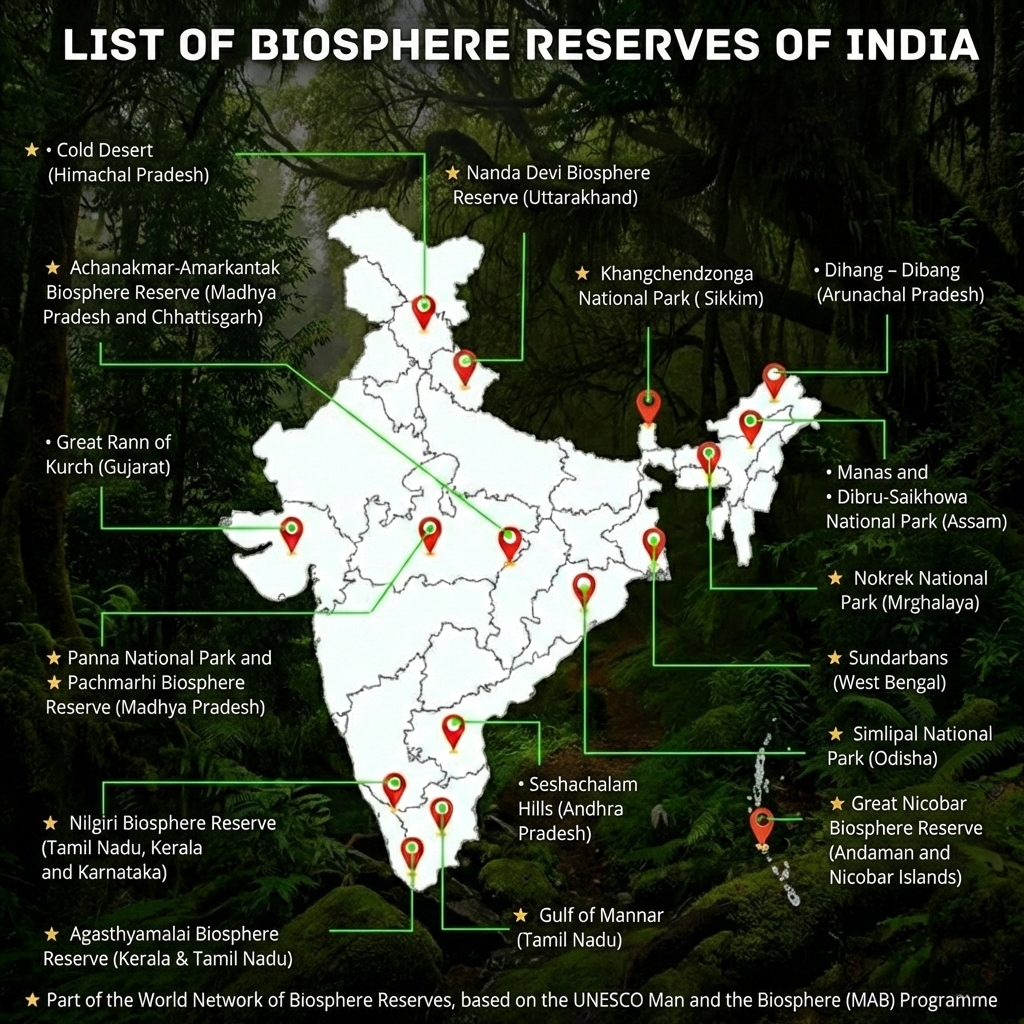
List of 18 Biosphere Reserves in India
India has 18 Biosphere Reserves, covering approximately 91,425 sq. km diverse geographical and ecological regions.
| S. No. | Biosphere Reserves | Year | State |
|---|---|---|---|
| 1. | Nilgiri Biosphere Reserve | 1986 | Tamil Nadu, Kerala and Karnataka |
| 2. | Nanda Devi Biosphere Reserve | 1988 | Uttarakhand |
| 3. | Nokrek Biosphere Reserve | 1988 | Meghalaya |
| 4. | Gulf of Mannar Biosphere Reserve | 1989 | Tamil Nadu |
| 5. | Sundarbans Biosphere Reserve | 1989 | West Bengal |
| 6. | Manas Biosphere Reserve | 1989 | Assam |
| 7. | Great Nicobar Island Biosphere Reserve | 1989 | Andaman and Nicobar Islands |
| 8. | Simlipal Biosphere Reserve | 1994 | Odisha |
| 9. | Dibru-saikhova Biosphere Reserve | 1997 | Assam |
| 10. | Dihang-Dibang Biosphere Reserve | 1998 | Arunachal Pradesh |
| 11. | Pachmarhi Biosphere Reserve | 1999 | Madhya Pradesh |
| 12. | Kanchenjunga Biosphere Reserve | 2000 | Sikkim |
| 13. | Agastyamalai Biosphere Reserve | 2001 | Kerala, Tamil Nadu |
| 14. | Achanakmar-Amarkantak Biosphere Reserve | 2005 | Madhya Pradesh, Chhattisgarh |
| 15. | Rann of Kutch Biosphere Reserve | 2008 | Gujarat |
| 16. | Cold Desert Biosphere Reserve | 2009 | Himachal Pradesh |
| 17. | Seshachalam Hills Biosphere Reserve | 2010 | Andhra Pradesh |
| 18. | Panna Biosphere Reserve | 2011 | Madhya Pradesh |
Nilgiri Biosphere Reserve
- India’s first biosphere reserve and forms part of the Western Ghats biodiversity hotspot.
- Location: Tamil Nadu, Kerala, Karnataka (Southern India).
- Wildlife Sanctuary: Establishes as a Nilgiri Wildlife Sanctuary in 1936.
- Designated as Biosphere Reserve (India): It became India’s first biosphere reserve in 1986.
- UNESCO Recognition: Designated under MAB Programme in 2000 and became India’s first reserve under UNESCO’s Man and Biosphere Programme; declared UNESCO World Heritage Site in 2012 as part of the Western Ghats.
- Area: 5,520 sq. km (Core: 1,240; Buffer: 3,574; Transition: 706 sq. km) (Tamil Nadu: 2,537.6 sq. km., Kerala: 1,455.4 sq. km., Karnataka: 1,527.4 sq. km.).
- Peaks: Doddabetta (2,637 m), Mukurthi, Tadiandamol, Brahmagiri located within Nilgiri Biosphere Reserve.
- Rivers: Bhavani, Moyar, Kabini, Chaliyar, Punampuzha flow through the Nilgiri Biosphere Reserve.
- Lakes: Pykara, Avalanche, Upper Bhavani, Emerald situated within Nilgiri Biosphere Reserve.
- National Parks: Bandipur National Park, Nagarahole National Park, Mukurthi National Park, Silent Valley National Park situated within the Nilgiri Biosphere Reserve.
- Wildlife Sanctuaries: Mudumalai Wildlife Sanctuary, Sathyamangalam Wildlife Sanctuary, Wayanad Wildlife Sanctuary situated within the Nilgiri Biosphere Reserve.
- Plants: Shola forests and evergreen trees.
- Animals: Endemic species like Nilgiri Tahr, Nilgiri Langur and endangered species like Bengal Tiger, Lion-tailed Macaque.
- Tribes: Todas, Kotas, Irulas, Kurumbas, Paniyas, Cholanaickens, Allar tribes live within Nilgiri Biosphere Reserve.
- Famous Places: Ooty, Coonoor, Wayanad; Nilgiri, Malappuram, Chamarajanagar districts.
Nanda Devi Biosphere Reserve
- Location: Located in Uttarakhand across Chamoli (3,387.07 Sq. Km), Pithoragarh (1,312.85 Sq. Km) , and Almora (706.11 Sq. Km) districts in the Kumaon and Garhwal regions of the Western Himalayas.
- National Parks: Nanda Devi National Park and Valley of Flowers National Park was established by Indian government in 1982.
- Designated as Biosphere Reserve (India): The Nanda Devi National Park and Valley of Flowers National Park were designated as the Nanda Devi Biosphere Reserve by the Government of India in 1988.
- UNESCO Recognition: Nanda Devi Biosphere Reserve declared a UNESCO World Heritage Site in 1988 and included under the Man and the Biosphere (MAB) Programme in 2004.
- Area: Spreads over about 6,407 sq. km (Core area: 712.12 square kilometers, Buffer zone: 5,148.57 square kilometers, Transition zone: 546.34 square kilometers).
- Peaks: Major peaks include Nanda Devi, Trishul, Kamet, Dunagiri, Changbang, and Nanda Ghungti.
- Rivers: Drained by important Himalayan rivers such as Alaknanda, Dhauli Ganga, Rishi Ganga, and Pushpawati.
- Lakes: Notable high-altitude lakes include Roopkund Lake and Hemkund Lake.
- Plants: Vegetation includes alpine meadows, coniferous forests, rhododendrons, and rare medicinal plants like Brahma Kamal.
- Animals: Supports species such as Snow Leopard, Musk Deer, Blue Sheep, Himalayan Tahr, and Himalayan Monal.
- Famous Places: Includes Nanda Devi National Park, Valley of Flowers, Hemkund Sahib, and Roopkund.
Nokrek Biosphere Reserve
- Location: Situated in the Garo Hills district of Meghalaya, northeastern India.
- Establishment as a National Park: Nokrek National Park was established in 1986.
- Designated as Biosphere Reserve (India): Nokrek National Park declared a biosphere reserve by Government of India in 1988.
- UNESCO Recognition: Declared a Biosphere Reserve under UNESCO’s Man and the Biosphere (MAB) Programme in 2009.
- Area: Covers about 820 sq. km (Core: 47.48 sq. km; Buffer: 227.92 sq. km; Transition: 544.60 sq. km).
- National Park Status: Nokrek National Park was established in 1986 and upgraded to a biosphere reserve in 1988.
- Hills: Located on the Nokrek (Tura) Range, part of the Meghalaya Plateau. Nokrek Range is part of the larger Garo Hills.
- Rivers: Ganol, Dareng, and Simsang rivers drain the biosphere reserve.
- Tribes: Predominantly inhabited by the indigenous Garo tribe.
- Plants: Evergreen and subtropical forests with bamboo, orchids, medicinal plants, and endemic species like wild lemon and grand rasamala.
- Animals: Notable fauna include Western Hoolock Gibbon (only ape species found in India), Red Panda, Clouded Leopard, hornbills, and reptiles like King Cobra and Green Pit Viper.
Gulf of Mannar Marine Biosphere Reserve
- Location: Situated along the southeastern coast of Tamil Nadu, India, extending into coastal areas of Sri Lanka (Mannar District).
- Marine National Park: Declared as the Gulf of Mannar Marine National Park in 1986 by the Government of India.
- Designated as Marine Biosphere Reserve (India): Designated as a Marine Biosphere Reserve in 1989, with the Marine National Park forming the core zone.
- UNESCO Recognition: Declared a UNESCO World Biosphere Reserve in 2001 under the Man and the Biosphere (MAB) Programme.
- Ramsar Status: Listed as a Ramsar Wetland of International Importance in 2022.
- Area: Covers approximately 10,500 sq. km (4,049 square miles), making it India’s largest marine biosphere reserve.
- Ecosystems: Characterized by coral reefs, seagrass meadows, mangroves, mudflats, and sandy beaches.
- Rivers (Inflow): Thamirabarani, Vaigai, and Pamban rivers contribute freshwater and nutrients to the gulf.
- Plants: Mangroves, extensive seagrass beds, coastal vegetation, and reef-associated algae.
- Animals: Dugong (sea cow), dolphins, sea turtles, coral reef fishes, seabirds, and whales.
- Famous Places: Rameswaram Island, Kilakarai, Thoothukudi, Ramanathapuram coastal belt.
Sundarbans Biosphere Reserve
- Location: Delta of Ganges, Brahmaputra, and Meghna rivers; spans southern West Bengal (India) and southwestern Bangladesh.
- UNESCO World Heritage Site: Designated in 1987 for unique mangrove ecosystem and biodiversity.
- Biosphere Reserve (India): Officially declared by Government of India in 1989.
- UNESCO Biosphere Reserve: Recognized in 2001 under UNESCO MAB Programme.
- Ramsar Site: Declared in 2019 for wetland conservation and ecological importance.
- Area: ~10,000 sq. km; ~60% in Bangladesh (Khulna, Satkhira, Bagerhat districts), ~40% in India (South & North 24 Parganas districts).
- National Parks & Wildlife Sanctuaries: Indian part includes Sundarbans National Park, Sajnekhali Wildlife Sanctuary, Lothian Wildlife Sanctuary, and Haliday Wildlife Sanctuary.
- Rivers: Ganges, Brahmaputra, Meghna converge to form dynamic delta with brackish water and mangroves.
- Plants: Sundari, Goran, Keora, Hental, Passur, Nypa Palm, ferns etc.
- Animals: Bengal Tiger, Dugong, Ganges River Dolphin, Irrawaddy Dolphin, Mangrove Pitta, Estuarine Crocodile, Green Sea Turtle.
- Famous Features: Largest mangrove forest globally; named after Sundari trees; protects coastlines from cyclones, tidal surges, and erosion.
Manas Biosphere Reserve
- Location: Bongaigaon and Barpeta districts, Assam, India, at the foothills of the Eastern Himalayas, bordering Bhutan.
- Ancient & Indigenous Presence: Habitation by Bodo and Adivasi tribes.
- Colonial Era: Establishment of tea estates in the region.
- Wildlife Sanctuary: Declared Manas Wildlife Sanctuary in 1950.
- Tiger Reserve: Designated under Project Tiger in 1973.
- UNESCO World Heritage Site: Recognized in 1985 for biodiversity and natural beauty.
- Biosphere Reserve (India): Declared Manas Biosphere Reserve in 1989 by Indian government..
- National Park: Upgraded to National Park status in 1990.
- Area: Approximately 950 sq. km.
- Hills: Foothills of the Eastern Himalayas and parts of the Bhutan Hills, contributing to topographical diversity.
- River: Manas River flows through the reserve, originating in Bhutan and joining the Brahmaputra, shaping wetlands and riverine forests.
- Plants: Subtropical evergreen forests, deciduous forests.
- Animals: Bengal tiger, Indian rhinoceros, Wild Water Buffalo, Red Panda, golden langur, dhole, Bengal florican, Gharial Assam roofed turtle etc.
Great Nicobar Island Biosphere Reserve
- Location: Southernmost part of Andaman & Nicobar Islands, India; covers majority of Great Nicobar Island (~85%).
- Prehistoric Habitation: Inhabited by Shompen and Nicobarese tribes for thousands of years.
- Colonial Era: British presence established in the 18th century.
- Biosphere Reserve Established: Great Nicobar Biosphere Reserve officially designated in 1989.
- National Parks Incorporated: Includes two Indian National Parks — Campbell Bay National Park in the northern part of Great Nicobar Island and Galathea National Park in the southern interior, both gazetted in 1992.
- UNESCO Recognition: Designated as a UNESCO Biosphere Reserve in 2013.
- Area: Total ~8851,038.7 km²; (Core: 536.23 km², Buffer: 348.77 km², Transition: Terrestrial 100.7 km², Marine 53 km²).
- Tribe: Indigenous Shompen and Nicobarese.
- Plants: Tropical rainforest trees, mangroves, epiphytes.
- Animals: Nicobar Long-tailed Macaque, Crab-eating Macaque, Dugong, Nicobar Megapode, Saltwater Crocodile, Andaman Water Monitor, Giant Leatherback Sea Turtle.
Simlipal Biosphere Reserve
- Location: Mayurbhanj district, Odisha, India; northeastern Odisha near Jharkhand border.
- Early Inhabitants: Indigenous tribes including Santhal, Munda, Ho, and Bhumija.
- Tiger Reserve: Declared in 1956 to protect Royal Bengal Tiger.
- Project Tiger Inclusion: Incorporated under Project Tiger in 1973.
- Wildlife Sanctuary: Declared in 1979 for broader biodiversity protection.
- Biosphere Reserve Established: Indian government officially designated in 1994.
- UNESCO Recognition: Included in UNESCO’s World Network of Biosphere Reserves in 2009.
- Area: Total ~5,569 km²; (Core: 845 km², Buffer: 2,129 km², Transition: 2,595 km²). Simlipal National Park forms the core area of the reserve.
- Elephant Reserve: Form part of Similipal-Kuldiha-Hadgarh (Mayurbhanj) Elephant Reserve.
- Rivers: Palpala, Khairi, Budhabalanga, Salandi.
- Waterfalls: Barehipani (399 m), Joranda (152 m), Sitakund, Ramatirtha.
- Tribe: Erenga Kharia, Mankirdia, Ho, Gond, Munda.
- Plants: Sal, Semul, Bamboo, Semi-evergreen & moist deciduous trees.
- Animals: Royal Bengal Tiger, Asian Elephant, Indian Wild Dog, Mugger Crocodile.
Dibru-Saikhowa Biosphere Reserve
- Location: Northeastern Assam, India; spread across Dibrugarh and Tinsukia districts at the confluence of Brahmaputra, Dibru, and Lohit rivers.
- Geographical Significance: Part of Eastern Himalayan biodiversity hotspot with extensive wetlands, grasslands, and riverine islands.
- Wildlife Sanctuary: Declared as Dibru River Wildlife Sanctuary in 1986.
- Biosphere Reserve Established: Upgraded and designated as Dibru–Saikhowa Biosphere Reserve in 1997 by Indian government.
- National Park Status: Core sanctuary area declared Dibru–Saikhowa National Park in 1999.
- Area: Total ~765 km²; Core (National Park): ~340 km².
- Rivers: Brahmaputra (northern boundary), Dibru River, Lohit River.
- Tribe: Mishing, Deori, Sonowal Kachari.
- Plants: Semi-evergreen forests, moist mixed deciduous forests.
- Animals: Feral horses, Bengal Tiger, Indian Elephant, Indian Rhinoceros, Asiatic Water Buffalo, Hoolock Gibbon, Gangetic Dolphin, White-winged Wood Duck (endangered), White-rumped Vulture, Assam Roofed Turtle.
- Feral Horses: The Dibru-Saikhowa Biosphere Reserve is known for its Feral Horses population.
Dihang-Dibang Biosphere Reserve
- Location: Spread across Dibang Valley, Upper Siang, and West Siang districts of Arunachal Pradesh in Eastern Himalayas.
- Geographical Setting: Lies between the Dihang (Siang/Brahmaputra) River to the south and the Dibang River to the north; part of Eastern Himalayan biodiversity hotspot.
- Biosphere Reserve Established: Declared by Government of India in 1998.
- National Park and Wildlife Sanctuary: Includes Mouling National Park and Dibang Wildlife Sanctuary.
- Area: Total ~5,112 km²; (Core: ~4,095 km², Buffer: ~1,017 km²).
- Hills: Dominated by the Mishmi Hills.
- Rivers: Named after Dihang River (Siang/Brahmaputra) and Dibang River—both major tributaries of the Brahmaputra.
- Tribe: Traditionally inhabited by Mishmi, Idu Mishmi, Adi, and Tangsa tribes.
- Vegetation Types: Subtropical broad-leaved forests, subtropical pine forests, temperate broad-leaved forests, temperate conifer forests, sub-alpine shrubs, alpine meadows, bamboo brakes, grasslands.
- Plants: Oak, laurel, magnolia, chestnut, rhododendron, fir, spruce, bamboo, alpine grasses and shrubs.
- Animals: Tiger, Asian Elephant, Mishmi Takin, Red Panda, Musk Deer, Asiatic Black Bear.
Pachmarhi Biosphere Reserve
- Location: Spread across Narmadapuram, Betul, and Chhindwara districts of Madhya Pradesh, India.
- Naming: Named after the hill station town of Pachmarhi.
- Geographical Importance: Part of Satpura–Maikal landscape; Often recognized as “Genetic Express Highway” linking two biological hot spots corridor viz. Eastern Himalayas and the Western Ghats.
- Biosphere Reserve (India): Declared by Government of India in 1999.
- UNESCO Recognition: Included in UNESCO’s Man and the Biosphere (MAB) Programme in 2009.
- Area: ~4,926 km² total; includes Bori Sanctuary (518 km²), Pachmarhi Sanctuary (461.37 km²), and Satpura National Park (524.37 km²).
- Tiger Reserve: Forms part of Satpura Tiger Reserve along with Bori, Pachmarhi Sanctuaries and Satpura National Park.
- Hills: Located in Satpura Range; Dhoopgarh (1,350 m) is the highest peak in the reserve.
- River: Denwa River (tributary of Tawa River) flows through the reserve.
- Tribe: Gond and Korku tribes with long-standing forest-based livelihoods.
- Rock Shelters: Numerous sandstone rock shelters used by prehistoric human communities in Pachmarhi region.
- Cave Paintings: Prehistoric rock art (up to ~10,000 years old) depicting hunting, rituals, animals, and daily life.
- Forest Type: Tropical moist deciduous forests with teak, sal, bamboo, tendu, and mahua.
- Animals: Tiger, Indian Bison (Gaur), Sambar, Malabar Pied Hornbill, Monitor Lizard.
Kanchenjunga Biosphere Reserve
- Location: Located in the North and West Sikkim districts of Sikkim, India; situated in eastern Himalayas; bordered by Nepal (west) and Tibet/China (north-west).
- Altitude Range: ~1,220 m to 8,586 m (one of the highest ecosystems in the world).
- National Park Status: Declared Khangchendzonga National Park in 1977.
- Biosphere Reserve (India): Notified by Government of India in 2000.
- UNESCO World Heritage Site: Khangchendzonga National Park inscribed in 2016 (Mixed category – natural & cultural).
- UNESCO Biosphere Reserve: Included in UNESCO MAB Programme in 2018 (11th from India).
- Area: Total ~2,931.12 km² (Core: 1,784 km²; Buffer: 835.92 km²; Transition: 311.20 km²); entire Khangchendzonga National Park is the part of core zone.
- Hills / Peaks: Mount Khangchendzonga (8,586 m) – world’s 3rd highest peak; “Five Treasures of Snow”.
- River: Teesta River forms the eastern boundary of the reserve.
- Lakes: ~73 high-altitude lakes across 7 watersheds (~3.34 km²).
- Glaciers: Zemu Glacier (largest in Eastern Himalayas; ~26 km long).
- Tribes: Lepcha, Bhutia, and Limbu communities with strong sacred landscape traditions.
- Cultural Significance: Mount Khangchendzonga revered as a sacred deity by local tribes.
- Ecosystem Range: Sub-tropical to alpine and Arctic conditions; multiple ecolines.
- Biodiversity Hotspot: Part of the Eastern Himalaya global biodiversity hotspot.
- Forest Types: Sub-tropical, temperate, sub-alpine, alpine forests and meadows.
- Plants: Oak, chestnut, maple, rhododendron, fir, birch, juniper; over 500 orchid species recorded in the region.
- Animals: Snow Leopard, Red Panda, Himalayan Black Bear, Musk Deer, Himalayan Tahr, Tibetan Wolf, Himalayan Monal, Himalayan Griffon.
Agastyamalai Biosphere Reserve
- Location: Southern Western Ghats of India; spans Kerala (Pathanamthitta, Kollam, Thiruvananthapuram districts ) and Tamil Nadu (Tirunelveli, Kanyakumari districts).
- Biosphere Reserve (India): Declared by Government of India in 2001.
- UNESCO Recognition: Designated as UNESCO Biosphere Reserve in 2016 under MAB Programme.
- Area: Total ~3,500 km² (Core ~1,135 km²; Buffer ~1,445 km²; Transition ~920 km²) (Kerala ~1,828 km²; Tamil Nadu ~1,672 km²).
- Protected Areas Incorporated: Includes Shendurney, Peppara and Neyyar Wildlife Sanctuaries, and Kalakkad–Mundanthurai Tiger Reserve.
- Peak: Named after Agasthyamala (Agasthyamalai) Peak, ~1,868 m; one of the highest peaks in southern Western Ghats.
- Ecological Significance: Vital ecological corridor linking high Western Ghats with southern plains; part of Western Ghats global biodiversity hotspot.
- Rivers: Neyyar, Karamana, Shendurney and Tamirabarani originate from or flow through the reserve.
- Tribe: Predominantly Kani tribe.
- Plants: Tropical evergreen forests, grasslands, wetlands; rich medicinal plants (Arogyapacha), orchids and endemic species.
- Medicinal Plants: The Agastyamalai Biosphere Reserve region is renowned for its medicinal plants (including Arogyapacha) and is often referred to as the “cradle of traditional Indian medicine.”
- Animals: Bengal Tiger, Asian Elephant, Lion-tailed Macaque, Nilgiri Langur, Malabar Trogon, Malabar Pit Viper.
Achanakmar-Amarkantak Biosphere Reserve
- Location: Central India; spread across Chhattisgarh (Bilaspur ~68.1%) and Madhya Pradesh (Anuppur ~16.2%, Dindori ~15.7%); lies in Deccan Plateau and Central Highlands.
- Cultural Significance: Amarkantak is a major Hindu pilgrimage centre; meeting point of Vindhya and Satpura ranges.
- Wildlife Sanctuary Origin: Achanakmar Wildlife Sanctuary established in 1975.
- Tiger Reserve: Declared Achanakmar Tiger Reserve under Project Tiger in 2009.
- Addition of Amarkantak Region: Expanded to include the sacred Amarkantak area; Amarkantak is a major Hindu pilgrimage centre; meeting point of Vindhya and Satpura ranges.
- Biosphere Reserve (India): Declared by Government of India in 2005; 14th BR of India, 1st of Chhattisgarh, 2nd of Madhya Pradesh.
- UNESCO Recognition: Included in UNESCO World Network of Biosphere Reserves in 2012 under MAB Programme.
- Area: Total ~3,835.51 km² (Core ~551.50 km²; Buffer ~1,955.87 km²; Transition ~1,328 km²).
- Hills: Situated in the eastern Maikal Hills, part of the Satpura Range.
- River Origin: Source region of major rivers — Narmada (west-flowing), Son and Johilla (tributaries of Ganga system).
- Forest Type: Predominantly tropical moist deciduous forests (~63%); tropical dry deciduous forests in southern parts.
- Plants: Sal, teak, bamboo, mahua, tendu; rich medicinal plants like neem, amla, guduchi; endemic and rare species present.
- Animals: Bengal Tiger, Leopard, Sloth Bear, Gaur, Sambar, Wild Dog, Giant Squirrel, Sacred Grove Bush Frog.
Rann of Kutch Biosphere Reserve
- Location: Located in the Kutch, Rajkot, Surendra Nagar and Patan Civil Districts of Gujarat, India; Western part of Gujarat; extends from Gulf of Kutch to India–Pakistan border.
- Biosphere Reserve Status (India): Declared by Government of India in 2008.
- Area: ~12,454 km² comprising Great Rann of Kachchh (GRK) and Little Rann of Kachchh (LRK); largest biosphere reserve in India.
- Protected Areas Included: Kachchh Desert Sanctuary (GRK) and Wild Ass Sanctuary (LRK).
- Banni Grasslands: Part of the reserve; one of Asia’s finest tropical grasslands (~3,847 km²).
- Tribe: Rabari pastoral community known for camel herding and embroidery.
- Ecosystem Type: Seasonal salt marsh with saline desert plains, wetlands, grasslands and thorn scrub forests.
- Flora: Halophytes, salt-tolerant shrubs, grasses and thorn scrub vegetation.
- Fauna: Indian Wild Ass, Chinkara, Indian Wolf, Flamingos, Great Indian Bustard, Desert reptiles.
- Flagship Species: Indian Wild Ass (Ghudkhar).
Cold Desert Biosphere Reserve
- Location: Spiti Valley, Western Himalayas, Himachal Pradesh.
- Geological History: Region formed from sediments of the ancient Tethys Sea.
- Cultural History: Inhabited by Tibetan-speaking communities; strong Buddhist influence; part of ancient Indo-Tibetan trade routes.
- Biosphere Reserve Status (India): Declared in 2009.
- Area: ~7,770 km² (3,000 square miles).
- Protected Areas Included: Pin Valley National Park; Chandratal, Sarchu and Kibber Wildlife Sanctuaries.
- River: Spiti River (originates from Kunzum Range; tributary of Sutlej).
- Ecosystem: High-altitude cold desert with rugged mountains, barren terrain and sparse vegetation.
- Plants: Alpine grasses (Kobresia, Poa), dryland shrubs (Caragana, Ephedra), wildflowers (Primula, Gentiana), riparian willows.
- Endemic Plants: Spiti Poppy (Meconopsis spitiensis), Spiti Juniper.
- Animals: Snow Leopard, Himalayan Ibex, Tibetan Wolf, Tibetan Gazelle, Himalayan Brown Bear, Musk Deer, Red Fox, Marmot, Woolly Hare., Black-necked Crane, Griffon Vulture, Ladakh Agama.
Seshachalam Hills Biosphere Reserve
- Location: Eastern Ghats; spread across Chittoor and Kadapa districts of Andhra Pradesh; situated near the Andhra Pradesh–Tamil Nadu border; ~12 km northwest of Tirupati.
- Cultural & Religious Significance: Seshachalam Hills are sacred due to the Tirumala Venkateswara Temple at Tirupati; one of the most important Hindu pilgrimage centres in India.
- Wildlife Sanctuary Origin: Seshachalam Hills notified as a Wildlife Sanctuary in 1985 for conservation of flora and fauna.
- Biosphere Reserve (India): Declared a Biosphere Reserve by Government of India in 2010 to promote biodiversity conservation and sustainable development.
- Area: Total ~4,755 km² (Core ~750 km²; Buffer ~1,865 km²; Transition ~2,140 km²).
- Hills: Part of the Seshachalam Hills range of the Eastern Ghats; Srivenkateshwara National Park is located in Seshachalam Hills.
- Tribe: Inhabited mainly by the Yanadi tribe; traditionally dependent on forest resources and medicinal plants.
- Forest Type: Dry deciduous forests, semi-evergreen forests, scrublands, and grasslands.
- Plants: Red Sanders (endemic and endangered), Shorea species, Terminalia species, bamboo, Albizia, Acacia, medicinal plants.
- Animals: Tiger, Indian Elephant, Sambar, Indian Giant Squirrel, Bonnet Macaque, Painted Stork, Yellow-throated Bulbul, Indian Monitor Lizard, Malabar Gliding Frog, Indian Bullfrog.
Panna Biosphere Reserve
- Location: Central India; located in Panna and Chhatarpur districts of Madhya Pradesh; near Khajuraho (~25 km).
- Cultural & Historical Significance: Region has Paleolithic rock paintings and cave art; reflects ancient human habitation and early civilizations.
- National Park Origin: Panna National Park established in 1981 for conservation of dry deciduous forests and wildlife.
- Tiger Reserve: Declared Panna Tiger Reserve in 1994 after merger with Gangau Wildlife Sanctuary under Project Tiger.
- Biosphere Reserve (India): Notified as a Biosphere Reserve by Government of India in 2011.
- UNESCO Recognition: Declared a UNESCO Biosphere Reserve in 2020 under the Man and the Biosphere (MAB) Programme; third UNESCO BR of Madhya Pradesh after Pachmarhi and Amarkantak.
- Area: Total ~2,998.98 km² (Core ~792.53 km²; Buffer ~987.20 km²; Transition ~1,219.25 km²).
- Protected Areas Included: Panna National Park; sections I, III & IV of Gangau Wildlife Sanctuary; Reserved Forests of North Panna Forest Division.
- Hills: Located in the Vindhya Range.
- River: Ken River flows through the reserve.
- Tribes: Gond tribe; Khairuas (Khairwar); Yadavas (Dauvas); communities dependent on forests and traditional livelihoods.
- Forest Type: Predominantly tropical dry deciduous forests; grasslands and riparian vegetation along riverbanks.
- Plants: Teak, sal, mahua, tendu, bamboo, jamun; medicinal plants like neem, amla, safed musli, kalmegh, ashwagandha.
- Animals: Bengal Tiger, Sloth Bear, Indian Wolf, Four-horned Antelope, Sambar, Chinkara, Wild Dog, Giant Squirrel, Indian Vulture, Bar-headed Goose, Mugger Crocodile, Monitor Lizard.
UNESCO Biosphere Reserve in India
Out of 18, 13 Biosphere Reserves are recognized by UNESCO under the World Network of Biosphere Reserves (WNBR). All Biosphere Reserves are created by national governments to conserve biodiversity and promote sustainable development. However, only some of them receive international recognition from UNESCO. These areas remain under the sovereign control of the respective countries.
| S. No. | UNESCO Biosphere Reserves | Year | State |
|---|---|---|---|
| 1. | Nilgiri Biosphere Reserve | 2000 | Tamil Nadu, Kerala, Karnataka |
| 2. | Gulf of Mannar Biosphere Reserve | 2001 | Tamil Nadu |
| 3. | Sundarbans Biosphere Reserve | 2001 | West Bengal |
| 4. | Nanda Devi Biosphere Reserve | 2004 | Uttarakhand |
| 5. | Nokrek Biosphere Reserve | 2009 | Meghalaya |
| 6. | Simlipal Biosphere Reserve | 2009 | Odisha |
| 7. | Pachmarhi Biosphere Reserve | 2009 | Madhya Pradesh |
| 8. | Achanakmar–Amarkantak Biosphere Reserve | 2012 | Madhya Pradesh, Chhattisgarh |
| 9. | Great Nicobar Island Biosphere Reserve | 2013 | Andaman and Nicobar Islands |
| 10. | Agastyamalai Biosphere Reserve | 2016 | Kerala, Tamil Nadu |
| 11. | Kanchenjunga Biosphere Reserve | 2018 | Sikkim |
| 12. | Panna Biosphere Reserve | 2020 | Madhya Pradesh |
| 13. | Cold Desert Biosphere Reserve | 2025 | Himachal Pradesh |
What is a UNESCO Biosphere Reserve?
A UNESCO Biosphere Reserve is a Biosphere Reserve that is internationally recognized under UNESCO’s Man and the Biosphere (MAB) Programme and included in the World Network of Biosphere Reserves (WNBR) for conserving biodiversity while promoting sustainable development and scientific research. These reserves serve as models where people and nature coexist in a balanced manner.
What is the UNESCO Man and Biosphere Programme?
The UNESCO Man and Biosphere (MAB) Programme is an international scientific programme launched in 1971 to promote a balanced relationship between people and nature. It focuses on conserving biodiversity, supporting sustainable development, and encouraging research in different ecosystems.
Under this programme, Biosphere Reserves are designated as living laboratories where conservation, community welfare, and sustainable use of natural resources go hand in hand.
UNESCO Man and Biosphere Programme in India
India actively participates in UNESCO’s Man and Biosphere (MAB) Programme to conserve biodiversity while promoting sustainable development. Under this initiative:
- India has 18 Biosphere Reserves, of which 13 are UNESCO-recognized.
- The Ministry of Environment, Forest and Climate Change (MoEFCC) administers the programme through a Centrally Sponsored Scheme.
- The scheme follows a cost-sharing model: 60:40 (Central:State) and 90:10 for North-Eastern & Himalayan states.
- Biosphere Reserves act as living laboratories, linking ecological protection with community welfare and sustainable livelihoods.
First Biosphere Reserves in India
The first biosphere reserve in India is the Nilgiri Biosphere Reserve (Tamil Nadu, Kerala, Karnataka), established in 1986 to conserve the rich biodiversity of the Western Ghats. Following this, India designated other “firsts” in different ecological categories. The table below lists these first biosphere reserves in India in chronological order.
| Category | Biosphere Reserve | Year | State(s) |
|---|---|---|---|
| First Biosphere Reserve of India | Nilgiri Biosphere Reserve | 1986 | Tamil Nadu, Kerala, Karnataka |
| First Himalayan Biosphere Reserve | Nanda Devi Biosphere Reserve | 1988 | Uttarakhand |
| First Marine Biosphere Reserve | Gulf of Mannar Biosphere Reserve | 1989 | Tamil Nadu |
| First Island Biosphere Reserve | Great Nicobar Biosphere Reserve | 1989 | Andaman & Nicobar Islands |
| First Desert Biosphere Reserve | Rann of Kutch Biosphere Reserve | 2008 | Gujarat |
Largest Biosphere Reserve in India
The Rann of Kutch Biosphere Reserve in Gujarat is the largest biosphere reserve in India. The table below lists the Top 5 Largest Biosphere Reserves in India based on their size.
| Rank | Biosphere Reserve | Area (Approx.) | State(s) |
|---|---|---|---|
| 1 | Rann of Kutch | 12,454 sq km | Gujarat |
| 2 | Gulf of Mannar | 10,500 sq km | Tamil Nadu |
| 3 | Sundarbans | 9,630 sq km | West Bengal |
| 4 | Cold Desert | 7,770 sq km | Himachal Pradesh |
| 5 | Nanda Devi | 6,407 sq km | Uttarakhand |
Smallest Biosphere Reserve in India
The Dibru–Saikhowa Biosphere Reserve in Assam is the smallest biosphere reserve in India. The table below lists the Top 5 Smallest Biosphere Reserves in India based on their size.
| Rank | Biosphere Reserve | Area (Approx.) | State(s) |
|---|---|---|---|
| 1 | Dibru–Saikhowa | 765 sq km | Assam |
| 2 | Nokrek | 820 sq km | Meghalaya |
| 3 | Great Nicobar | 885 sq km | Andaman and Nicobar Islands |
| 4 | Manas | 950 sq km | Assam |
| 5 | Kanchenjunga | 2,931 sq km | Sikkim |
Difference Between National Parks and Biosphere Reserves
| Feature | National Parks | Biosphere Reserves |
|---|---|---|
| Purpose | Protect wildlife and biodiversity in a specific area; strict conservation | Combine biodiversity conservation with sustainable use; balance humans & nature |
| Legal Basis (India) | Wildlife Protection Act, 1972 | UNESCO Man and Biosphere (MAB) Programme & Government of India notification |
| Human Activity | No human settlement; limited tourism allowed | Human settlements allowed in buffer & transition zones; sustainable use permitted |
| Size | Usually smaller (can range from a few sq km to hundreds) | Generally larger, covering core, buffer, and transition areas (thousands of sq km) |
| Zoning | Single protected area | Three zones: Core (strictly protected), Buffer (limited use), Transition (sustainable activities) |
| Flora & Fauna Focus | Focused on species and habitat protection | Focused on ecosystems, biodiversity, and human-environment interactions |
| Examples (India) | Jim Corbett, Kaziranga, Gir | Nilgiri, Seshachalam, Panna, Achanakmar-Amarkantak |
| Management | Strictly by Forest/Wildlife Dept.; limited local involvement | Multi-stakeholder approach: government + local communities + NGOs + research institutions |
| International Recognition | No mandatory international recognition | Can be recognized by UNESCO under MAB Programme |
FAQs
Q. What are biosphere reserves in India?
A. Biosphere reserves in India are protected areas designated to conserve biodiversity, promote sustainable development, and maintain ecological balance. They serve as sites for research, education, and demonstration of sustainable practices while safeguarding cultural and natural heritage.
Q. What are the three zones of the biosphere reserve?
A. Biosphere reserves have three main zones: the core area (strictly protected), the buffer zone (limited human activity), and the transition area (sustainable development and human settlements).
Q. What are the three types of biosphere reserves?
A. They can be categorized as terrestrial, coastal and marine, and island biosphere reserves.
Q. How many Biosphere Reserves are there in India?
A. India has 18 biosphere reserves spread across different states and ecological regions.
Q. Which state has the highest number of Biosphere Reserves in India?
A. Madhya Pradesh (3) and Tamil Nadu (3) both have the highest number of biosphere reserves in India.
Q. Who launched the biosphere reserve Programme?
A. The Biosphere Reserve Programme was launched by UNESCO under its Man and the Biosphere (MAB) Programme in 1971.
Q. Who gave the first concept of Biosphere Reserves?
A. The concept was first proposed by UNESCO under the MAB Programme in 1971.
Q. How many Biosphere Reserves in India are recognised by UNESCO?
A. 13 biosphere reserves in India are recognised by UNESCO as part of the World Network of Biosphere Reserves under the MAB Programme.
Q. Which is India’s first biosphere reserve?
A. Nilgiri Biosphere Reserve, established in 1986, is India’s first biosphere reserve.
Q. What is the oldest biosphere reserve in India?
A. Nilgiri Biosphere Reserve (1986) is the oldest biosphere reserve in India.
Q. Which is the newest biosphere reserve in India?
A. Panna Biosphere Reserve in Madhya Pradesh, notified in 2011, is the newest biosphere reserve in India.
Q. Which is the largest biosphere reserve in India?
A. The largest biosphere reserve in India is the Great Rann of Kutch Biosphere Reserve in Gujarat, covering approximately 12,454 sq km, known for its salt marshes, desert ecosystem, and habitat for the endangered Indian Wild Ass.
Q. Which is the smallest biosphere reserve in India?
A. Dibru-Saikhowa Biosphere Reserve in Assam, covering approximately 765 sq km, is the smallest, with diverse moist forests, grasslands, and wetlands along the Brahmaputra and Lohit Rivers.
Q. Which is the only marine biosphere reserve in India?
A. Gulf of Mannar Biosphere Reserve in Tamil Nadu is India’s only marine biosphere reserve.
Q. Which is the first private biosphere reserve in India?
A. Rajaji Raghati Biosphere Reserve (RRB), Uttarakhand is India’s first private biosphere reserve. It is situated adjoining Rajaji National Park and spans about 35 acres.
Q. What are the biggest threats to the biosphere?
A. The biggest threats include habitat destruction, deforestation, pollution, climate change, and unsustainable exploitation of resources.
Q. What are the two factors damaging the biosphere?
A. Human activities and natural environmental changes are the two major factors damaging the biosphere.
Q. How are humans affected by the biosphere?
A. Humans depend on the biosphere for essential resources. Damage to the biosphere can lead to climate change, resource depletion, loss of biodiversity, and disruption of ecosystem services, directly impacting human survival and well-being.