
The Strait of Hormuz is arguably the most significant maritime chokepoint in modern global history due to its outsized role in the transportation of energy resources and its geopolitical importance. A narrow waterway linking the Persian Gulf to the Gulf of Oman and the Arabian Sea, the Strait acts as a lifeline for global oil and liquefied natural gas (LNG) shipments — and a potential flashpoint for international tensions.
The world’s energy and trading architecture depends on this narrow passage, which makes it a central focus of geopolitical strategy for oil-exporting countries, consuming nations, and naval powers.
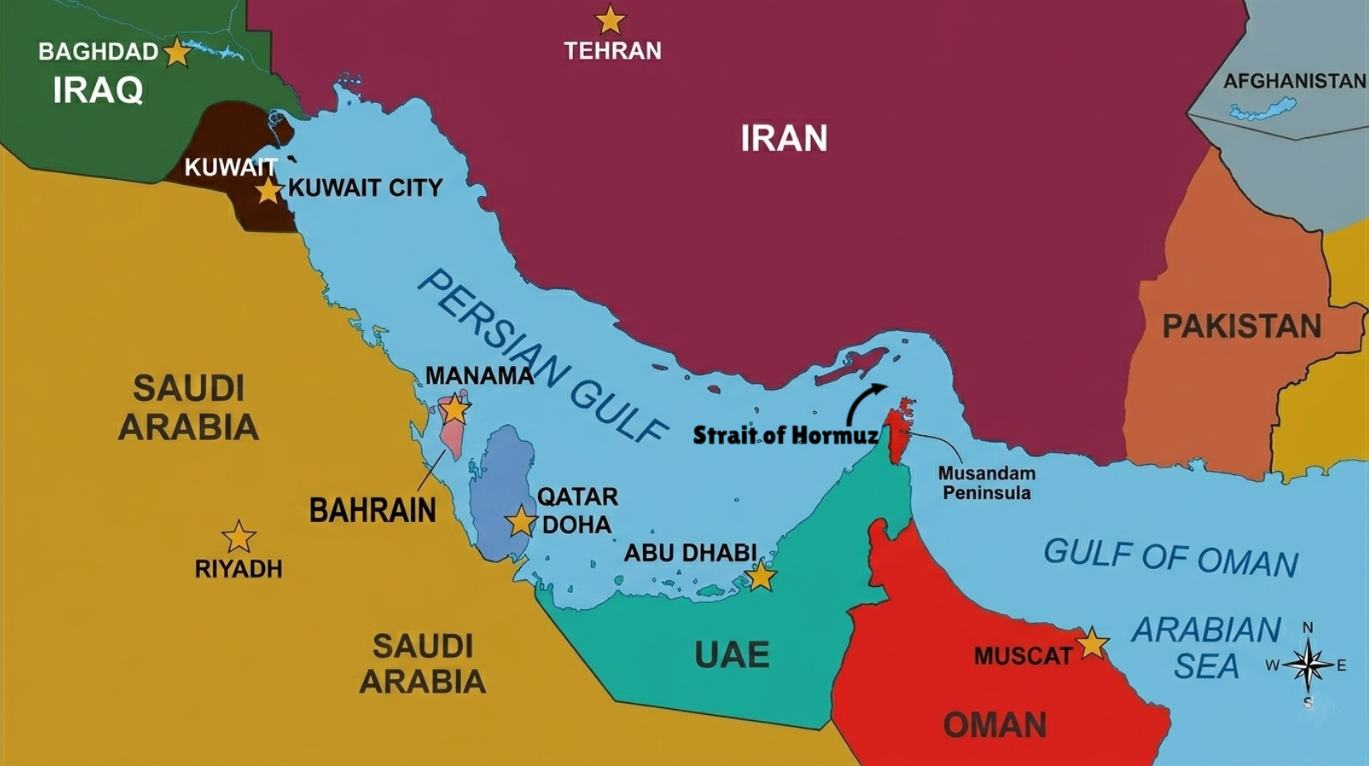
Table of Contents
Why in News
- Global oil markets are bracing for a potential price shock following escalation of hostilities in West Asia.
- Israel and United States launched air strikes on Iran on February 28, 2026, triggering retaliation from Tehran.
- Iran announced the closure of the Strait of Hormuz after the death of Ayatollah Ali Khamenei.
What is Strait of Hormuz?
- The Strait of Hormuz is a narrow but strategically vital waterway connecting the Persian Gulf to the Gulf of Oman and the Arabian Sea.
- It is located between the southern coast of Iran and the northern coast of Oman’s Musandam Peninsula and serves as the only sea passage from the Persian Gulf to the open ocean.
- The Strait is about 167 km (104 miles) long.
- The narrowest width of the strait is about 33 kilometers (21 miles).
- The shipping lanes within the strait are only about 3 kilometers wide in each direction.
- It falls within the territorial waters of both Iran and Oman.
- The strait is considered one of the world’s most important maritime chokepoints for global energy trade.
- A significant portion of the world’s oil and liquefied natural gas (LNG) passes through this route daily.
History of Strait of Hormuz
The Strait of Hormuz has a long and storied history, evolving from a major medieval trading hub into one of the most important strategic and energy chokepoints in the modern world.
Ancient & Medieval Maritime Hub
- Early Trade: From at least the 10th century, the strait served as a crucial maritime route for high-value goods such as silk, spices, and porcelain traveling between China, India, and the Middle East.
- The Kingdom of Hormuz: The original mainland port, known as Old Hormuz, was relocated to Hormuz Island around 1300 to avoid raids. By the 15th century, the island had become a globally recognized trading center, praised by Chinese Admiral Zheng He for its “universal wealth and luxury.”
Colonial Rivalries (1500s–1800s)
- Portuguese Conquest: In 1507, Afonso de Albuquerque launched the first Portuguese assault, gaining full control by 1515 to dominate spice trade routes and block rival Muslim shipping.
- Ottoman Challenges: The Ottoman Empire attempted several naval campaigns, including Piri Reis’s 1552 expedition, but failed to oust the Portuguese.
- Anglo-Persian Takeover: In 1622, a combined force of the English East India Company and the Persian Safavid Empire expelled the Portuguese, ending over a century of colonial dominance.
The “Tanker War” Era (1980–1988)
- Iran-Iraq War: During the “Tanker War,” both Iran and Iraq targeted each other’s oil tankers to disrupt energy exports.
- U.S. Military Action: After the USS Samuel B. Roberts struck an Iranian mine in 1988, the U.S. launched Operation Praying Mantis, the largest naval surface engagement since World War II, destroying multiple Iranian vessels.
- Civilian Tragedy: On July 3, 1988, the USS Vincennes mistakenly shot down Iran Air Flight 655 over the strait, killing 290 civilians.
Modern Geopolitical Flashpoints (2000s–Present)
- Nuclear and Political Tensions: Throughout the 2010s and 2020s, Iran has periodically threatened to close the strait in response to Western sanctions or military pressure.
- Naval Incidents: Regional tensions rose during 2011–2012 and again in 2019, with tanker attacks and ship seizures making global headlines.
- Recent Escalations: Following U.S. and Israeli strikes on Iranian facilities in June 2025 and February 2026, Iran’s Revolutionary Guard reportedly warned ships to avoid the strait, causing a sharp reduction in traffic and fears of a blockade.
Strait of Hormuz Importance
The Strait of Hormuz is one of the world’s most critical maritime chokepoints, playing an indispensable role in global energy trade and international geopolitics. Its strategic and economic importance extends far beyond its narrow geographic footprint.
Global Oil Transit
- Approximately 20% of the world’s crude oil supply (roughly 20–21 million barrels per day) passes through the strait.
- Over 80% of this oil is exported to Asian countries, including China, India, Japan, and South Korea, making it a lifeline for energy-hungry economies.
- Major Gulf oil producers, including Saudi Arabia, UAE, Kuwait, Qatar, Iraq, and Iran, rely heavily on Hormuz for timely exports.
Critical LNG Route
- The strait handles nearly 20% of global liquefied natural gas (LNG) shipments, most of which originate from Qatar.
- LNG exports through Hormuz supply power, industrial, and domestic energy markets in Asia and parts of Europe, emphasizing its role in diversified energy security.
Geopolitical Significance
- The strait serves as a strategic military and political flashpoint due to its narrow width and proximity to Iran, Oman, and key shipping lanes.
- Regional tensions, sanctions, or military operations can rapidly disrupt traffic, making the strait a barometer of Middle East geopolitical stability.
Economic Importance
- Any disruption in the strait can trigger immediate spikes in global oil prices, which cascade into higher energy costs worldwide.
- Increased freight and insurance costs during instability directly affect global supply chains.
- Exporters face operational delays, higher transaction costs, and potential loss of revenue.
Limited Alternative Routes
- Unlike other regions, there are no practical alternative sea routes that can fully replace Hormuz.
- While pipelines from Saudi Arabia and UAE to the Red Sea exist, their capacity is limited and cannot handle the total volume of crude passing through the strait.
- Long reroutes via the Cape of Good Hope add 15–20 days to shipments, increase fuel costs, and strain logistics.
Strategic Military Value
- Control over or threats to the Strait of Hormuz allows a country, particularly Iran, to influence global energy markets and exert pressure during geopolitical crises.
- Naval presence, surveillance, and military exercises in the strait are closely monitored by the US, China, and other major powers.
Global Supply Chain Vulnerability
- Beyond oil and LNG, the strait is vital for the shipping of petrochemicals, refined products, and industrial raw materials.
- Disruptions can affect manufacturing hubs, transportation networks, and commodity prices worldwide.
Insurance and Risk Management Impact
- Conflict or closure risks sharply increase war-risk insurance premiums for tankers, adding to the cost of energy imports globally.
- Speculative trading in energy markets often amplifies price volatility during even short-term tensions in the region.
Environmental Sensitivity
- The high volume of oil and gas transit makes the strait vulnerable to accidents, spills, or blockages, which can have widespread environmental and economic consequences for the Gulf region and beyond.
Potential Consequences if the Strait of Hormuz Remains Closed
Global Energy Disruption
- The strait handles about 17–20 million barrels of crude oil daily, roughly 20% of global petroleum consumption.
- Major oil exporters relying on Hormuz: Saudi Arabia, Iraq, Kuwait, UAE, Qatar, Iran.
- Qatar, a leading LNG exporter, also depends on the strait for gas shipments to Asia and parts of Europe.
- Closure would sharply inflate oil and gas prices; Brent crude has already surged close to $73 per barrel.
- Sea freight rates could increase by nearly 40% if the strait remains blocked beyond a week.
Impact on India
- India imports more than 85% of its crude oil, with roughly 50% from Middle Eastern suppliers using Hormuz.
- Prolonged closure could:
- Raise fuel prices sharply and weaken the rupee.
- Slow GDP growth due to increased logistics and industrial costs.
- Inflate export costs for critical sectors like transport, fertilisers, rice, and manufacturing.
- India exported nearly $47.6 billion in non-oil goods to Gulf countries, about 13% of total non-oil exports, highlighting exposure to shipping disruptions.
Impact on China
- China imports about 10 million barrels of crude oil daily, with 40% passing through Hormuz.
- Pipeline alternatives from Russia and Central Asia cover only a fraction of China’s needs.
- A blockade would risk industrial slowdown, disrupt global supply chains, and trigger worldwide economic ripple effects.
Impact on Japan and South Korea
- Japan imports over 70% of its oil from the Middle East, with South Korea facing similar reliance.
- A prolonged energy shock would increase power generation and manufacturing costs, hurting export-driven economies.
Impact on UAE and Gulf Exporters
- Any disruption could increase logistics costs and reduce export revenues.
- Oil shocks historically correlate with economic downturns in Gulf economies.
Why Strait of Hormuz Closure Triggers Oil Price Panic
Supply Chain Disruption
Even a temporary closure of the Strait of Hormuz can severely disrupt global oil supply chains because nearly one-fifth of the world’s crude oil and a significant portion of LNG pass through this narrow corridor. Refineries in Asia, Europe, and beyond rely on steady tanker arrivals, and any interruption immediately creates uncertainty in supply scheduling, refinery operations, and downstream fuel distribution networks.
Immediate Shipping Delays
Escalating tensions can cause vessels to slow down, wait offshore, or temporarily avoid the strait, reducing overall traffic flow. Tanker congestion, port backlogs, and slower turnaround times can quickly develop, resulting in reduced daily oil availability in international markets, even if physical infrastructure remains undamaged.
Rising Insurance Premiums
Marine insurers classify conflict-prone waters as high-risk zones. During geopolitical instability, war-risk insurance premiums for tankers can surge sharply. These additional costs are passed on to charterers and refiners, increasing the landed cost of crude oil and LNG shipments.
Limited Alternative Routes
The Strait of Hormuz has very few viable bypass options. While some Gulf countries operate pipelines to alternate ports, these cannot match the strait’s export capacity. Prolonged disruption may force vessels to reroute around theCape of Good Hope, adding 15–20 days to shipments bound for Europe and the United States. This extended transit increases operational expenses, fuel consumption, and transaction costs, tightening supply further.
Higher Crude Prices
Oil markets are highly sensitive to geopolitical risk. Even the perception of constrained supply can trigger speculative trading, pushing benchmark prices like Brent crude higher. Reduced physical supply combined with rising shipping and insurance costs typically results in sustained upward pressure on global crude oil prices, contributing to inflation, higher fuel costs, and economic uncertainty worldwide
Impact of Strait of Hormuz Closure on India
India’s Dependence on the Strait
- Dependence on Crude Oil: India imports more than 85% of its crude oil, with roughly 50% of India’s oil imports (2.5–2.7 million barrels per day) transit through the Strait of Hormuz.
- Key Suppliers via Hormuz: Iraq, Saudi Arabia, UAE, and Kuwait.
- India imports over 85% of its crude oil requirement, making it highly import dependent.
- Approximately 60% of India’s LNG imports and 80–85% of LPG imports also transit through Hormuz.
Greater Vulnerability: LPG and LNG
- LPG imports are more vulnerable because India imports 80–85% of its needs, mostly from Gulf suppliers.
- India does not maintain strategic LPG reserves comparable to crude reserves.
- Around 60% of LNG imports pass through Hormuz, and structural buffers are limited.
- Spot cargo availability for LPG and LNG is thin, making prolonged disruption more challenging.
Potential Risks if Hormuz Is Disrupted
- Price Shock: Even temporary closures or threats of disruption can raise crude import costs due to geopolitical risk premiums. A spike in international oil prices would directly affect fuel, diesel, and LPG prices in India. Every $1 per barrel rise in oil prices may raise India’s annual oil import bill by $1.8–2 billion.
- Freight & Insurance Costs: Heightened risks in Hormuz would increase marine insurance premiums and freight charges for Indian importers, raising the overall cost of crude and refined petroleum products.
- Macro-Economic Impact:
- Higher crude costs can strain India’s balance of payments.
- Rising fuel prices would feed into inflation, affecting transportation, industrial production, and household budgets.
- The twin deficits — fiscal deficit and current account deficit — could widen under sustained disruption.
- Exports & Industry: Indirect effects on transport, fertilizers, rice, and MSME sectors reliant on fuel and logistics. Higher crude prices may reduce marketing margins and profitability of oil marketing companies.
- Remittance Flows: Prolonged regional instability could affect Indian workers in Gulf countries, potentially disrupting remittance inflows that support domestic consumption and economic stability.
Mitigation Strategies for India
- Diversified Sourcing: India imports crude from over 40 countries, including Russia, the United States, West Africa, and Latin America, providing some flexibility to adjust supply in case of disruptions from the Gulf.
- Strategic Petroleum Reserves (SPR): Emergency reserves allow India to maintain crude supply for short-term disruptions, ensuring continuity in refining and domestic fuel supply.
- Refinery Stocks: Operational stocks at refinery depots for diesel, gasoline, ATF, and LPG provide immediate buffer capacity to offset temporary supply interruptions.
- Russian Oil Pivot: In the event of Gulf disruptions, Indian refiners can redirect imports from Russian crude in the Indian Ocean, offering an alternative supply route to mitigate immediate shortages.
Frequently Asked Questions about the Strait of Hormuz
Q. Which country owns the Strait of Hormuz?
A. The Strait of Hormuz lies between Iran and Oman, and both countries have territorial waters in the strait. No single country owns it entirely; instead, it is a shared international waterway with Iran controlling the northern shore and Oman the southern.
Q. Has Iran ever closed the Strait of Hormuz?
A. Yes, Iran has periodically threatened or partially closed the strait in response to political tensions or sanctions. While full-scale closures are rare, temporary restrictions on commercial shipping and warnings to international vessels have occurred during periods of conflict or heightened geopolitical tension.
Q. Why is the Strait of Hormuz important?
A. The strait is one of the world’s most critical maritime chokepoints. Around 20% of global oil and 20% of LNG passes through it daily, connecting Gulf countries like Saudi Arabia, UAE, Iraq, Kuwait, Iran, and Qatar to international markets. Its narrowness, high traffic, and lack of alternative routes make it vital for global energy security.
Q. What will happen if the Strait of Hormuz is closed?
A. Closure would disrupt global oil and gas supply, causing crude prices to surge, increasing shipping and insurance costs, and forcing some vessels to take long alternative routes. Economies highly dependent on Middle Eastern energy, including India, China, Japan, and South Korea, would face higher fuel costs and potential industrial slowdowns.
Q. Is there any alternative to the Strait of Hormuz?
A. Limited alternatives exist, mainly pipelines from Gulf countries to the Red Sea or overland routes. However, their capacity is far below the strait’s daily oil and LNG throughput, making them insufficient to fully replace Hormuz in case of prolonged closure.
Q. How can we bypass the Strait of Hormuz?
A. Ships can reroute around the Cape of Good Hope, which connects the Arabian Sea to the Atlantic Ocean. However, this adds 15–20 days to shipments, increases fuel and operational costs, and delays deliveries to Europe, the United States, and other markets.
Q. Who legally controls the Strait of Hormuz?
A. Under international law, particularly the United Nations Convention on the Law of the Sea (UNCLOS), the strait is an international waterway. Both Iran and Oman have sovereignty over their territorial waters, but ships of all nations have the right of transit passage for commercial and military vessels.
Q. How much oil does the US get from the Strait of Hormuz?
A. The US imports a relatively small portion of its oil directly from the Strait of Hormuz compared to Asian countries. Most of US crude comes from the Americas, but disruptions can still affect global oil prices, indirectly increasing costs for American consumers and industries.
Q. Does closing the Strait of Hormuz affect the US?
A. Yes, a closure would raise global oil prices, which would increase fuel and energy costs in the US. It could also destabilize energy markets, affect inflation, and impact industries reliant on petroleum products, even if direct imports through the strait are limited.
Q. How much oil does India get from the Strait of Hormuz?
A. Roughly 50% of India’s crude oil imports pass through the Strait of Hormuz, primarily from Iraq, Saudi Arabia, UAE, and Kuwait. This makes India highly dependent on the strait for its energy security.
Q. How does the Strait of Hormuz affect India?
A. Any disruption can lead to higher fuel prices, increased freight and insurance costs, and pressure on India’s balance of payments. Industries reliant on transportation, fertilizers, and logistics would face higher costs. Strategic reserves, alternative sourcing, and existing refinery stocks help mitigate short-term disruptions, but prolonged closure could impact GDP growth and inflation.